Submit a Picture
Our Email is example@gmail.com you can send us funny pictures and we will publish it on our website with your name.
Subscribe Via Email
Get latest update in you Inbox!!!


9GAG is your best source of fun.
Showing posts with label astronomy. Show all posts

A ROSE MADE OF GALAXIES


rose-made-of-galaxies
Photograph by NASA/ESA/STScI/AURA

In celebration of the 21st anniversary of the Hubble Space Telescope’s deployment into space, astronomers at the Space Telescope Science Institute in Baltimore, Md., pointed Hubble’s eye to an especially photogenic group of interacting galaxies called Arp 273.
The larger of the spiral galaxies, known as UGC 1810, has a disk that is tidally distorted into a rose-like shape by the gravitational tidal pull of the companion galaxy below it, known as UGC 1813. A swath of blue jewels across the top is the combined light from clusters of intensely bright and hot young blue stars. These massive stars glow fiercely in ultraviolet light.
The smaller, nearly edge-on companion shows distinct signs of intense star formation at its nucleus, perhaps triggered by the encounter with the companion galaxy.
A series of uncommon spiral patterns in the large galaxy is a tell-tale sign of interaction. The large, outer arm appears partially as a ring, a feature seen when interacting galaxies actually pass through one another. This suggests that the smaller companion actually dived deep, but off-center, through UGC 1810. The inner set of spiral arms is highly warped out of the plane with one of the arms going behind the bulge and coming back out the other side. How these two spiral patterns connect is still not precisely known.
The larger galaxy in the UGC 1810 – UGC 1813 pair has a mass that is about five times that of the smaller galaxy. In unequal pairs such as this, the relatively rapid passage of a companion galaxy produces the lopsided or asymmetric structure in the main spiral. Also in such encounters, the starburst activity typically begins in the minor galaxies earlier than in the major galaxies. These effects could be due to the fact that the smaller galaxies have consumed less of the gas present in their nucleus, from which new stars are born.
Arp 273 lies in the constellation Andromeda and is roughly 300 million light-years away from Earth. The image shows a tenuous tidal bridge of material between the two galaxies that are separated by tens of thousands of light-years from each other. The interaction was imaged on December 17, 2010, with Hubble’s Wide Field Camera 3 (WFC3).
This Hubble image is a composite of data taken with three separate filters on WFC3 that allow a broad range of wavelengths covering the ultraviolet, blue, and red portions of the spectrum.

Y U NO SHARE?

GRB Lights Up Ancient Hidden Galaxy


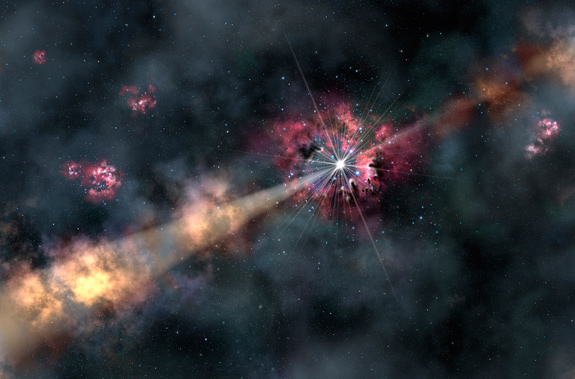
This artist's illustration depicts a gamma-ray burst illuminating clouds of interstellar gas in its host galaxy. By analyzing a recent gamma-ray burst, astronomers were able to learn about the chemistry of a galaxy 12.7 billion light-years from Earth. They discovered it contains only one-tenth of the heavy elements (metals) found in our solar system.  Credit: Gemini Observatory/AURA, artwork by Lynette Cook
This artist’s illustration depicts a gamma-ray burst illuminating clouds of interstellar gas in its host galaxy. By analyzing a recent gamma-ray burst, astronomers were able to learn about the chemistry of a galaxy 12.7 billion light-years from Earth. They discovered it contains only one-tenth of the heavy elements (metals) found in our solar system. Credit: Gemini Observatory/AURA, artwork by Lynette Cook
Once upon a time, more than 12.7 billion years ago, a star was poised on the edge of extinction. It made its home in a galaxy too small, too faint and too far away to even be spotted by the Hubble Space Telescope. Not that it would matter, because this star was going to end its life before the Earth formed. As it blew itself apart, it expelled its materials in twin jets which ripped through space at close to the speed of light – yet the light of its death throes outshone its parent galaxy by a million times.
“This star lived at a very interesting time, the so-called dark ages just a billion years after the Big Bang,” says lead author Ryan Chornock of the Harvard-Smithsonian Center for Astrophysics (CfA).


“In a sense, we’re forensic scientists investigating the death of a star and the life of a galaxy in the earliest phases of cosmic time,” he adds.
When this unsung star expired, it created one of the scariest things in astronomy… a gamma-ray burst (GRB). However, it wasn’t just a normal, garden variety GRB – it was long one, lasting more than four minutes. After century upon century of travel, the light reached our little corner of the Universe and was detected by NASA’s Swift spacecraft on June 6th. Chornock and his team quickly organized follow-up observations by the MMT Telescope in Arizona and the Gemini North telescope in Hawaii.
“We were able to get right on target in a matter of hours,” Chornock says. “That speed was crucial in detecting and studying the afterglow.”
Time to kick back and have a smoke? In a sense. The “afterglow” of a GRB happens when the jets impact the surrounding gas in an almost tsunami-like effect. As it sweeps up the material, it begins to heat and glow. As this light traverses the parent galaxy, it impacts clouds of interstellar gas, illuminating their spectra. Through these chemical signatures, astronomers are able to ascertain what gases the distant galaxy may have contained. As we know, all chemical elements heavier than hydrogen, helium, and lithium are the product of stars. Researchers refer to this as “metal content” and it takes a certain amount of time to accumulate. In the scheme of creation, the elements necessary for life – carbon and oxygen – didn’t exist. What Chornock and his team discovered was the GRB galaxy was host to only about a tenth of the “metals” in our solar system. What does that mean? In the eyes of the astronomers, rocky planets might have been able to form in that far away galaxy, but chances are good that life could not.
“At the time this star died, the universe was still getting ready for life. It didn’t have life yet, but was building the required elements,” says Chornock.
At a redshift of 5.9, or a distance of 12.7 billion light-years, GRB 130606A is one of the most distant gamma-ray bursts ever found.
“In the future we will be able to find and exploit even more distant GRBs with the planned Giant Magellan Telescope,” says Edo Berger of the CfA, a co-author on the publication.


Original Story Source: Harvard Smithsonian Center for Astrophysics News Release.


Y U NO SHARE?

Is Reality Real?


More documentary films
Y U NO SHARE?

SciShow: Great Minds

SciShow: Great Minds

SciShow delves into the minds of some of humanity’s greatest scientists. Some of them are:
Dmitri Mendeleev – brilliant Russian chemist, the man behind the periodic table.
Gregor Mendel – the Austrian monk who, with the help of a garden full of pea plants, discovered the fundamental properties of inheritance and paved the way for modern genetics.
Alan Turing – openly gay man in the early 20th century faced brutal prejudice that eventually led to his suicide, despite being a genius war hero who helped the Allies defeat the Nazis.
Fritz Haber – a great mind who is considered “the father chemical warfare,” but who also made discoveries and innovations that helped lead to the Green Revolution which is credited with preventing the starvation of over a billion people.
Elizabeth Blackburn – the Nobel Prize-winning Australian woman who discovered telomeres and telomerase, and helped scientists begin to understand the process of aging at a genetic level.
Nikola Tesla – bizarre and eccentric genius with the crazy eyes who spent his life increasing awesome wherever he went, and contributed in some way to pretty much every cool invention you can think of.
Nikola Tesla spoke eight languages and, at the time of his death, held over 700 patents and was being investigated by the US government for claiming to have invented a 60 million volt death ray. Tesla was an undisputed genius.
Y U NO SHARE?

2013’s solar maximum could be weakest since the dawn of the space age

2013’s solar maximum could be weakest since the dawn of the space age


So this is unexpected. The Sun is currently at the peak of its 11-year solar cycle. It should be awash with sunspots, solar flares, coronal mass ejections and the like. And yet, observations indicate our parent star has actually been pretty quiet this year – so quiet, in fact, this years solar max could go down as the weakest in a century.

"It’s the smallest maximum we’ve seen in the Space Age," said David Hathaway of NASA’s Marshall Space Flight Center yesterday via teleconference.

Earlier this year, there was speculation that scientists had miscalculated the maximum of the current cycle, though it’s become increasingly apparent that no, this is the maximum, it’s just a quiet one. And that, according to NASA, isn’t necessarily uncommon:

Conventional wisdom holds that solar activity swings back and forth like a simple pendulum. At one end of the cycle, there is a quiet time with few sunspots and flares. At the other end, Solar Max brings high sunspot numbers and solar storms. It’s a regular rhythm that repeats every 11 years.

Reality, however is more complicated. Astronomers have been counting sunspots for centuries, and they have seen that the solar cycle is not perfectly regular. For one thing, the back-and-forth swing in sunspot counts can take anywhere from 10 to 13 years to complete; also, the amplitude of the cycle varies. Some solar maxima are very weak, others very strong.

Back in March, solar physicist Dean Pesnell of the Goddard Space Flight Center hypothesized that the Sun could be experiencing a lull between two peaks in sunspot activity. A similar "twin peak" solar maximum, Pesnell said, occurred back in 1989, and again in 2001. The first peak of the current solar maximum, he said, reached its zenith in 2011, dipped in 2012, and continued through the beginning of 2013. "I am comfortable in saying that another peak will happen in 2013 and possibly last into 2014," he predicted at the time.

But 2014 is fast approaching, and still no signs of a second spike. Is this a bad thing? Hardly. Disappointing? You might think so, said Hathaway at yesterday’s conference, "but it’s quite the contrary."

SPACE.com gives an example of what Hathaway and his colleauges are taking away from this cycles tamer-than-usual antics:

North-south, or meridional, flows carry magnetic elements from sunspots to the sun’s poles, building up the polar magnetic fields until they eventually flip around the time of the solar maximum, Hathaway explained. Scientists are noticing that the strength of the polar fields when a new cycle begins influences the strength of the cycle, he added. For example, weak polar fields observed in 2008 led to the current weak cycle, while strong polar fields in 1986 spawned a strong Cycle 22.

The polar fields have been slowly reversing at this maximum, Hathaway said, suggesting that they are not going get much stronger during Cycle 24. This also sets the stage for an even smaller maximum during Cycle 25, scientists believe.

"We’re seeing fields that suggest the next sun cycle will be even weaker than this one," Hathaway said.

[...]

Read the full article at: io9.com
Y U NO SHARE?

These Cubesats Could Use Plasma Thrusters to Leave Our Solar System

These Cubesats Could Use Plasma Thrusters to Leave Our Solar System


Artist concept of a 5 kg CubeSat with CubeSat Ambipolar Thruster (CAT) firing in low Earth orbit. Via Kickstarter.
Cubesats are all the rage these days: they’re usually inexpensive and quick to build and they can tag along on launches already scheduled for other things. We think of cubesats as being almost “disposable” satellites – tiny spacecraft that go into Earth orbit for a short time, do their science and then burn up harmlessly in Earth’s atmosphere. But a team of scientists have a more long-term, long-distance plan for their cubesats. Benjamin Longmier and James Cutler from the University of Michigan want to build cubesats that have tiny plasma thruster engines that could propel them into deep space, maybe even interstellar space.
They have a vision of their plasma-thruster cubesat waving as it speeds past the Voyager spacecraft at the edge of our Solar System.

They are working on what they call the CubeSat Ambipolar Thruster (CAT), a new plasma propulsion system. This thruster technology doesn’t exist all in one piece yet, but Longmeir and Cutler said they could put it together in months, with just a little funding. The CAT plasma thruster will propel a 5kg satellite into deep space, far beyond Earth orbit, at 1/1000th the cost of previous missions.
They’ve begun a $200,000 Kickstarter campaign to help fund their project. Their ideas of what these thruster propelled cubesats could do are mind-bogglingly exciting: flying through the plumes of Enceladus to look for life, studying and tagging asteroids, formation flying through Earth’s magnetosphere to learn more about solar flares and the aurora or just an interplanetary message in a bottle lasting for hundreds of millions of years in orbit around the Sun.


They think they can get a satellite up and flying within 18 months.
“The traditional funding process starts with some seed data, a large government grant and a large number of milestones and gates to go through,” said Longmier in a press release from the University of Michigan. “We’d like to leverage Kickstarter funds to compress that timeline and go from initial seed data to flight in about 18 months, a much faster time scale than is possible with traditional grants.”


 The cubesats would be about as big as a loaf of bread and the thrusters – the first of its kind — would use superheated plasma directed through a magnetic field to propel the CubeSat. The duo says that with this technology, exploring interplanetary space and eventually other planets would become faster and cheaper than ever before. While plasma rockets have been used before, they’ve only been used on big spacecraft like Deep Space 1 and DAWN. Longmier and Cutler are miniaturizing the system. Most of the thruster components have been built and have been tested individually, but they need help through Kickstarter to assemble everything into one compact thruster unit for testing the integrated components in the lab, then in Earth orbit, and then interplanetary space. They’ve got more info on how the thrusters work on their Kickstarter page. I dare you to tell me this isn’t exciting
Y U NO SHARE?

Secrets of Body Language


Secrets of Body Language
Secrets of Body LanguageBody language is a form of non-verbal communication, which consists of body posture, gestures, facial expressions, and eye movements. Humans send and interpret such signals almost entirely subconsciously.
John Borg attests that human communication consists of 93 percent body language and paralinguistic cues, while only 7% of communication consists of words themselves; however, Albert Mehrabian, the researcher whose 1960s work is the source of these statistics, has stated that this is a misunderstanding of the findings.
Others assert that research has suggested that between 60 and 70 percent of all meaning is derived from nonverbal behavior.
Delve into the science of non-verbal signals as this very visual and highly entertaining expose reveals the hidden language in which 93% of human communication takes place.
From President Franklin D. Roosevelt, to British Prime Minister Winston Churchill and 2008 presidential hopefuls Senators Barack Obama and John McCain, see how both politicians and celebrities use the subtle movements of body language to persuade masses, establish power, and advance careers.


Y U NO SHARE?

The Friendship Case

The Friendship Case


The Friendship Case
Newspapers talked about it, people wanted to know, but nobody could penetrate the mystery. What was going on? Strange flying machines were playing the skies of Italy. It was the fifties. Some people took incredible photos, others were frightened and shouted “They’re here, they’re among us,” while still others believed that aliens came to help. But who were they; where were they from, and above all what did they want?
Until recently, the phenomenon of contactism, or the deliberate encounter, repeated over time, between man and evolved extraterrestrial entities, was believed to involve only a few chosen individuals, or contactees.
Many of them went down in history. George Adamski, Howard Menger, Eugenio Siragusa, just to name a few, all of them faithfully abided by this cliché. But in 2007, something happened that would change the cards on the table. Stefano Breccia, and engineer from Marche, living in Abruzzo, published some startling papers that seemed to reveal the story of repeated direct encounters between more than 100 people, and extraterrestrial beings living in numerous secret bases on our planet.
The main figure of the event told by Breccia is the writer Bruno Sammaciccia. The case is said to have taken place mainly in and around Pescara. It would all begin in 1956, and would last for many years. The film clips and photographs that have emerged so far are of considerable interest. But even more extraordinary are the testimonies of the individuals involved. Everyone called their story “friendship.” And that is the name that has come down to us today. Thanks to Stefano Breccia’s courage, one of the most awe-inspiring sagas in ufology has come to light. It wasn’t an easy decision to decide to make it known.
It all started from an idea from Bruno Sammaciccia. He’d been thinking about writing down his experiences, and then asked Breccia to be the one to do it. And so he was at his house for a month to record his stories. Then he put everything together. Besides granting his dear friend’s wishes, Breccia had set himself another objective. One reason is, he hoped that it might work as bait to encourage other people in the group to come forward.
Gaspare De Lama and his wife Mirella are among those still alive today who were involved in the “friendship” event, and who accepted Breccia’s invitation to come forward. They now live on the shores of Lake Como. Gaspare admired Stefano’s courage to expose himself so directly, despite being a well-known figure in science and academia. Gaspare De Lama became a fan of ufology in the late 40s and, together with his wife, sought a path to greater awareness. Even Gaspare’s mother took part in the events.

Y U NO SHARE?

60 Billion Habitable Planets in the Milky Way Alone?

60 Billion Habitable Planets in the Milky Way Alone? Astronomers say Yes!

An artist's conception of how common exoplanets are throughout the Milky Way Galaxy. Image Credit: Wikipedia
An artist’s conception of how common exoplanets are throughout the Milky Way Galaxy. Image Credit: Wikipedia
Lazada 468x60 2
A new study suggests that the number of habitable exoplanets within the Milky Way alone may reach 60 billion.
Previous research performed by a team at Harvard University suggested that there is one Earth-sized planet in the habitable zone of each red dwarf star. But researchers at the University of Chicago and Northwestern University have now extended the habitable zone and doubled this estimate.

The research team, lead by Dr. Jun Yang considered one more variable in their calculations: cloud cover. Most exoplanets are tidally locked to their host stars – one hemisphere continually faces the star, while one continuously faces away. These tidally locked planets have a permanent dayside and a permanent nightside.
One would expect the temperature gradient between the two to be very high, as the dayside is continuously receiving stellar flux, while the nightside is always in darkness. Computer simulations that take into account cloud cover show that this is not the case.
The dayside is covered by clouds, which lead to a “stabilizing cloud feedback” on climate.  It has a higher cloud albedo (more light is reflected off the clouds) and a lower greenhouse effect. The presence of clouds actually causes the dayside to be much cooler than expected.
“Tidally locked planets have low enough surface temperatures to be habitable,” explains Jang in his recently published paper. Cloud cover is so effective it even extends the habitable zone to twice the stellar flux. Planets twice as close to their host star are still cool enough to be habitable.
But these new statistics do not apply to just a few stars. Red dwarfs “represent about ¾ of the stars in the galaxy, so it applies to a huge number of planets,” Dr. Abbot, co-author on the paper, told Universe Today. It doubles the number of planets previously thought habitable throughout the entire galaxy.
Not only is the habitable zone around red dwarfs much larger, red dwarfs also live for much longer periods of time. In fact, the Universe is not old enough for any of these long-living stars to have died yet. This gives life the amount of time necessary to form. After all, it took human beings 4.5 billions years to appear on Earth.
Another study we reported on earlier also revised and extrapolated the habitable zone around red dwarf stars.
Future observations will verify this model by measuring the cloud temperatures. On the dayside, we will only be able to see the high cool clouds. A planet resembling this model will therefore look very cold on the dayside. In fact, “a planet that does show the cloud feedback will look hotter on the nightside than the dayside,” explains Abbot.
This effect will be testable with the James Webb Space Telescope.  All in all, the Milky Way is likely to be teeming with life.
Freelance Jobs
-->
Y U NO SHARE?

"Stephen Hawking's Grand Design" The Meaning of Life

"Stephen Hawking's Grand Design" The Meaning of Life


Freelance Jobs


Hawking tackles the question: Is there a meaning to life? Is there a purpose to our existence? Hawking explores this fascinating territory with fearless zeal as he questions the very nature of reality. You'll never look at yourself the same way again.

-->
Lazada 468x60 2
Lazada 300x250 1
Y U NO SHARE?

Story of everything by stephen hawkings

In two mind-blowing hours, Hawking reveals the wonders of the cosmos to a new generation. Delve into the mind of the world's most famous living scientist and reveal the splendor and majesty of the universe as never seen before. See how the universe began, how it creates stars, black holes and life - and how everything will end 


Lazada 468x60 2


Y U NO SHARE?

Today's Pageviews

LinkShare_468x60v1
Designed By Seo Blogger Templates | Xo so